

1. Sorry, the Introduction Is After the Text: The Book Derrida Was Waiting For
In “Hors livre,” (1972) Jacques Derrida identifies a constitutive paradox in the very idea of the preface. The preface is supposed to come before the book, to anticipate what is yet to be read and to make the future text present in advance. Yet it can only do so retrospectively: the work it claims to introduce has already been written. The preface therefore occupies a peculiar temporal position, preceding the text in the order of the book while necessarily coming after it in the order of its production. It speaks in advance from a position of after-the-fact knowledge: a structure Derrida associates with the future anterior, the strange temporality of a “what will have been.”
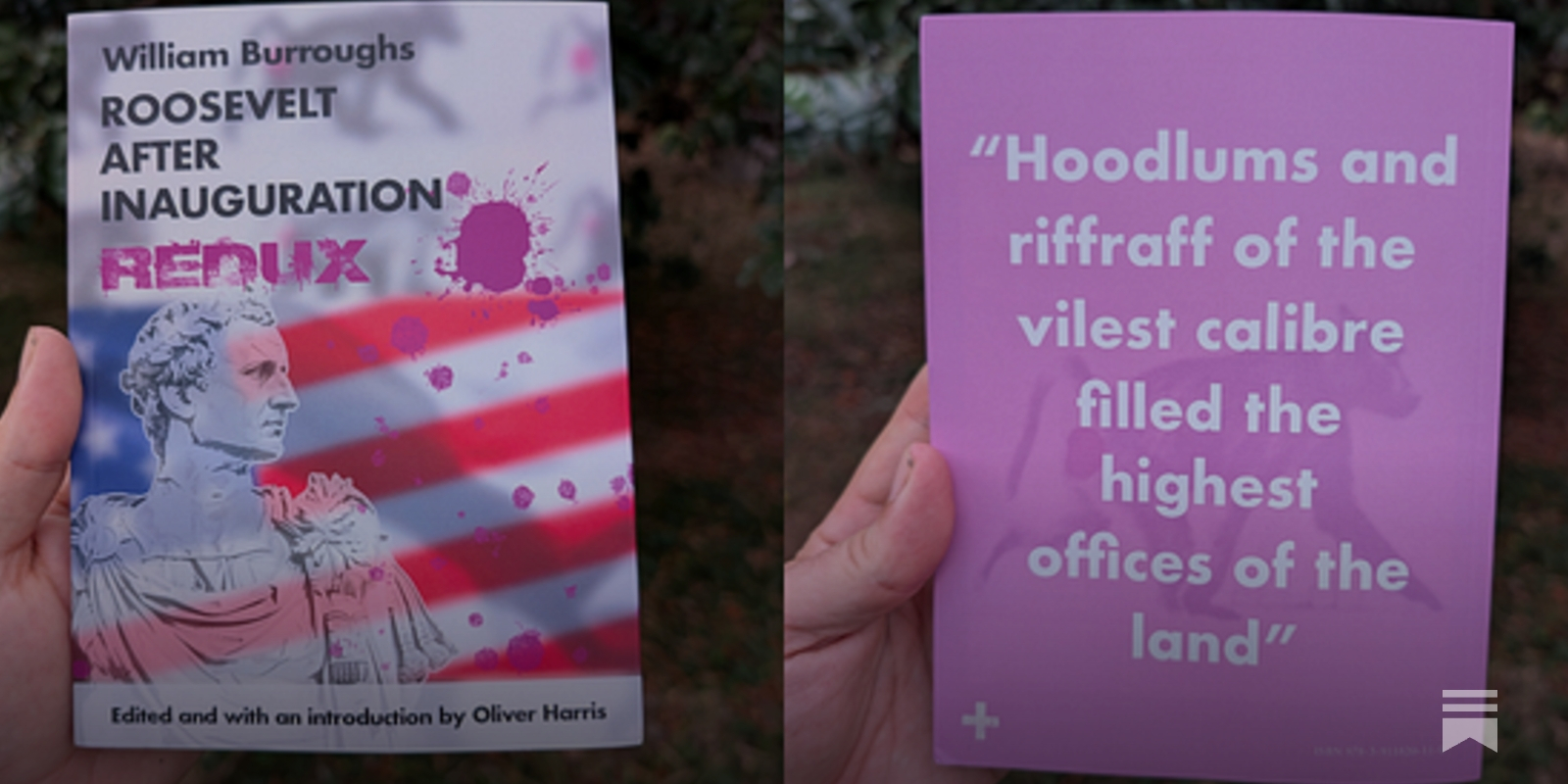
William Burroughs and Oliver Harris’s Roosevelt After Inauguration, Redux (Moloko Print, 2025) may well be the book Derrida was waiting for. It performs, quite literally, what Derrida finds structurally impossible in the conventional preface: it puts the introduction after the text. Burroughs’s Roosevelt After Inauguration occupies pages 9–14; only then, beginning on page 15 and extending all the way to page 148, does Harris’s “INTRODUCTION: burroughs our contemporary” appear. The introduction comes after the text it introduces. The joke is almost too perfect. But it is also more than a joke. For Redux does not merely reverse the customary order of book and introduction; it exposes the instability of the distinction between them. Derrida’s point in “Hors livre” is precisely that the preface is never simply an external supplement to an autonomous text. It is both inside and outside the book, both before and after it, and its apparent function of presenting the text in advance is haunted by the fact that it can only present what has already been written. Harris’s book materializes this temporal and spatial contradiction: the text comes first, but only retrospectively do we discover that it was also the beginning of Harris’s book.
Indeed, the reversal suggests that Burroughs’s five-page text is itself an introduction, not to another Burroughs text but to Harris’s 134-page work. We read Burroughs first, and only afterward discover what, in retrospect, those five pages have introduced us to. The conventional hierarchy is consequently turned inside out. What appears to be the primary text becomes a kind of prefatory threshold, while what is formally called an “INTRODUCTION” becomes the substantial body of the book.
Harris’s title makes this displacement explicit: “INTRODUCTION: burroughs our contemporary.” The word INTRODUCTION survives, but its conventional function has been displaced. Harris is no longer simply introducing the text that precedes his own writing. He is introducing Burroughs himself; or, more precisely, a Burroughs produced through the act of reading, editing, contextualizing, and reconstructing. The introduction has become the book, while the text it supposedly introduces has become its preface. Even the typography participates in this deconstruction. Harris does not write “Burroughs” but “burroughs,” in lowercase. The proper name has been deprived of its typographical elevation and inserted into the ordinary flow of the sentence: burroughs our contemporary. This is not merely a graphic whim. The lowercase name belongs to the same reversal by which Burroughs ceases to function simply as the sovereign authorial origin of the book. He becomes, instead, a figure to be produced in the present tense of Harris’s writing: not simply Burroughs as an author from the past, but “burroughs” as our contemporary. The name itself is thus brought down from the position of origin to the position of textual material. Harris’s “our contemporary” therefore does more than place Burroughs in the present. The possessive pronoun is quietly unstable: “our” means my contemporary, but it also invites the reader to make Burroughs their contemporary. What begins as Harris’s personal relation to Burroughs thus becomes an invitation to the reader to recognize the personal dimension of their own encounter with him.
What Roosevelt After Inauguration, Redux finally offers, then, is something very close to a Derridean joke with serious consequences: an introduction that comes after its text, a text that turns out to be an introduction, and an author whose proper name is lowercased precisely as the book elevates him into the present. Harris does not merely write an introduction to Burroughs. He makes the introduction itself the site at which the distinction between Burroughs’s text and Harris’s book begins to come undone.
2. Who Killed Chronology? The Crime Scene of the Archive
If Roosevelt After Inauguration, Redux is a joke on Derrida’s preface, it is also the culmination of something that has been developing throughout Oliver Harris’s unconventional work on Burroughs: the transformation of literary criticism into narrative. Harris has always approached Burroughs less like an academic critic approaching a stable literary object than like a detective approaching a crime scene. What makes Redux so remarkable is that this tendency reaches something close to its fullest form. What looks, at first glance, like a work of literary criticism, textual scholarship, or genetic criticism turns out to behave like a novel, and more specifically, like a detective novel whose characters are not invented human beings but writers, texts, manuscripts, letters, publications, editorial decisions, and historical events.
This may explain a minor but revealing disappointment expressed by Jonah Raskin in his review of the book. Raskin writes: “I wish that Harris had followed that history chronologically.” The complaint is understandable if the book is approached as a conventional scholarly reconstruction of the publication history of Roosevelt After Inauguration. But it misses, I think, the very principle that makes Harris’s book work. The history is not presented chronologically because Harris is not simply reconstructing a history. He is narrativizing the reconstruction itself. To arrange the history chronologically would be to give away the plot.
Harris’s method is closer to what he himself calls “reverse engineering Burroughs’ work” (102) than to a conventional linear history of publication. Yet even “reverse engineering” does not quite capture what happens in Redux. The book does not merely reverse-engineer a text by moving backward from its surviving forms toward an original manuscript. It turns the process of genetic criticism into a sequence of mysteries. A clue appears; a hypothesis follows; the hypothesis opens another question; a document seems to resolve the question only to reveal another discrepancy. The reader is repeatedly made to experience what the critic discovers. This is why the non-chronological structure matters. Harris does not simply tell us what happened. He makes us wonder what happened.
The distinction is crucial: in a conventional scholarly edition, the archival material is evidence presented in order to establish a history. In Redux, the evidence becomes plot. Manuscripts become clues; letters become testimonies; editions become crime scenes; editorial interventions become motives; omissions become suspicious absences. The history of Roosevelt After Inauguration is therefore not merely reconstructed, it is investigated.
And like a good detective novel, the investigation refuses to solve one mystery without producing another. The manuscript seems to establish one thing, until a typescript complicates it. A letter appears to clarify Burroughs’ intentions, only for the publication history to destabilize the apparent certainty of that intention. A suppressed edition becomes evidence of censorship, but also raises the question of why this particular text generated such anxiety. A later republication seems to stabilize the work’s textual identity, only to reveal another layer of editorial mediation. The book continually converts answers into new questions.
This is also why Redux should not be “spoiled” in the ordinary sense. The pleasure of Harris’s book lies not simply in knowing the final results of his research but in accompanying the process by which those results become possible. To read the book is to participate in a sequence of discoveries. The reader is not merely informed; the reader is recruited into the investigation. Harris has done something rather unusual with genetic criticism. He has made the critic’s own uncertainty narratable. Genetic criticism normally presents itself retrospectively: here is the manuscript, here is the typescript, here is the published version, and here is what we can now infer about the process that produced them. Harris instead preserves something of the temporal experience of discovery. We encounter the evidence before we know exactly what it means. We are allowed, and sometimes forced, to entertain hypotheses that later prove incomplete. The book therefore reproduces the movement of research rather than merely presenting its conclusions.
The result is a strange hybrid: part scholarly edition, part genetic criticism, part archival detective story, and part literary biography. But “part” may be the wrong word, because the achievement of Redux lies precisely in refusing to keep these genres apart. Harris does not alternate between scholarship and storytelling. He makes scholarship itself into storytelling.
This may also be why the book feels so different from a conventional work of Burroughs criticism. Its true protagonist is not even Burroughs alone. The protagonist is the text in motion: Roosevelt After Inauguration (a routine or a skit?) as it passes through manuscripts, letters, editors, magazines, printers, censorship, performances, republications, and successive historical presents. Burroughs is one of the book’s characters, but so are Allen Ginsberg, Lawrence Ferlinghetti, LeRoi Jones, Diane di Prima, Ed Sanders, John Sankey, Floating Bear, Fuck You!, The Yage Letters, Jonathan Swift, Louis-Ferdinand Céline, and the many documents through which the text acquires its successive lives.
Seen in this light, Raskin’s wish for a chronological account becomes almost the opposite of what the book is trying to accomplish. Chronology would give us the answer; Harris gives us the investigation. Chronology would turn the publication history into a sequence of events; Harris turns it into a mystery. And the difference is not merely stylistic. It changes the reader’s relationship to archival knowledge. Instead of standing outside the research and receiving its conclusions, we move through it as though we were discovering the evidence alongside the researcher. That is perhaps the deepest sense in which Roosevelt After Inauguration, Redux is a novel disguised as criticism. Its characters are texts, its plot is textual transmission, its setting is the archive, its clues are documents, and its suspense comes from the gap between what the reader knows and what the evidence has yet to reveal. Harris’s greatest achievement here is not that he has explained a twelve-hundred-word Burroughs text. It is that he has made the process of explaining those twelve hundred words into a narrative compelling enough to make the explanation itself the story.
3. What Does Trump Prefer: Purple-Assed Baboons, Freud’s Dreams, or Burroughs’ Hemorrhoids?
There is a sentence in Harris’s book that, to my mind, contains the key to the entire critical novel he has constructed. On page 60, reflecting on Ferlinghetti’s encounter with Burroughs’s text and the complicated history of its attempted publication, Harris writes: “what dreams were for Freud, coincidences were for Burroughs.” The sentence is easy to pass over as a brilliant aphorism. It should not be. It is, in fact, a methodological statement. For Freud, dreams provided access to the unconscious: apparently accidental images and narratives that, when interpreted, revealed hidden structures of desire. For Burroughs, Harris suggests, coincidence performs something analogous. A coincidence is never simply an accident. It is an event in which two apparently unrelated things suddenly reveal a connection. And this is precisely how Harris reads Burroughs. He does not merely trace influences upon Roosevelt After Inauguration; he follows coincidences outward, allowing each one to open another genealogical corridor. This is where the book most fully becomes a novel.
As the investigation proceeds, new characters enter the story. They do not enter simply because Burroughs happened to have read them. They enter because something in their texts, lives, dreams, or historical circumstances suddenly resonates with the genetic history of Burroughs’s text. Coleridge enters through Kubla Khan, a poem famously associated with an opium-induced vision and, like Roosevelt After Inauguration, originating in the peculiar territory where intoxication, dream, and literary composition become inseparable. Naked Lunch itself returns as part of this genealogy, not merely as another Burroughs work but as evidence of a recurring Burroughsian relation between drugs, dreams, accident, and textual production. Then Shakespeare enters, and with him the Roman plays; Caesar enters as both historical figure and literary character. Sinclair Lewis appears with It Can’t Happen Here, another apparently distant text that suddenly becomes contemporary to Burroughs’ routine. The letters between Burroughs and Ginsberg become characters in their own right, as do Céline’s Journey to the End of the Night, the history of Colombia’s civil war, and even the apparently absurd detail of Burroughs’s hemorrhoid operation. Nothing is too peripheral to become relevant, because relevance in Harris’s narrative is not determined by conventional literary influence. It is generated by connection.
This is what makes the genetic dimension of Redux so unusual. Genetic criticism ordinarily asks how a text came into being: what drafts preceded it, what revisions produced it, what sources or influences can be identified, what decisions shaped its final form. Harris asks a more Burroughsian question: what else is this text connected to? His genealogy therefore does not move in a straight line: it proliferates. One coincidence produces another, and each new connection changes the meaning of the previous one. The effect is cumulative but also recursive. We begin with a twelve-hundred-word text. Then the text opens onto Burroughs’ correspondence; the correspondence opens onto Ginsberg; Ginsberg opens onto Ferlinghetti; Ferlinghetti opens onto The Yage Letters; the political satire opens onto Sinclair Lewis, Shakespeare, Caesar, Céline, Colombia, and Swift; the history of writing opens onto drugs and dreams; and the body itself, right down to Burroughs’ hemorrhoids, becomes part of the archive. The apparent marginalia become central. The accidental becomes genealogical. This is why Harris’s phrase about Freud is so important. His book proceeds according to a hermeneutics of coincidence. He behaves as though coincidences were Burroughs’s unconscious made historical: not messages waiting to be decoded in a psychoanalytic sense, but encounters waiting to be connected. The critic becomes the reader of these connections, and the archive becomes a field in which apparently unrelated events repeatedly discover one another.
The detective story consequently grows larger and stranger as it proceeds. Harris’s investigation begins with Burroughs’ “Roosevelt” and eventually reaches from the purple-assed baboons of Burroughs’ text to Donald Trump. The distance between them is enormous, but that is precisely the point. In a Harrisian genealogy, distance does not disqualify a connection. It is often what makes the connection worth pursuing. And here, outside Harris’s book, one is tempted to add one more of those strange Burroughsian coincidences. When Donald Trump visited Saudi Arabia, in 2025, Mohammed bin Salman received him with a purple carpet rather than the conventional red carpet. In the same year, when Harris finished the book, photographs of Trump with conspicuous purple discolorations on his hands generated another wave of public speculation about the color. These events have no necessary causal relation to Burroughs’ purple-assed baboons. And yet, in the peculiar logic that Harris attributes to Burroughs, that may be precisely why they are interesting.
The point is not to claim that these things are secretly connected. It is to recognize a mode of reading in which coincidence itself becomes an object of attention. The coincidence is interesting because it is coincidence, because it appears to be accidental while producing an uncanny sense of recurrence. For Burroughs, as Harris puts it, coincidences are what dreams were for Freud. They are the moments when the apparently random begins to look as though it has been waiting for us.
Perhaps this is also why Redux refuses to give us a clean chronology. A chronology would separate events according to when they happened. Harris’s method brings them together according to the strange ways in which they become meaningful to one another. His is therefore not simply a history of Roosevelt After Inauguration. It is a novel of correspondences: a detective novel in which the clues do not merely lead backward to the origin of a text but outward into an ever-expanding network of texts, bodies, dreams, political events, illnesses, books, wars, authors, and accidents. And that may be the deepest sense in which Harris’s book is faithful to Burroughs. Burroughs’ writing repeatedly makes the world appear as a system of unexpected connections. Harris does something similar with the archive. He does not simply reconstruct Burroughs’ text; he constructs a world in which the text seems to have been surrounded, from the beginning, by all the things that would eventually explain it.
4. Burroughs, Trump, Cambridge, and What Happens Next
There is, finally, another coincidence worth considering. In the recently published William Burroughs in Context (2026), edited by Oliver Harris, Davis Schneiderman, and Alex Wermer-Colan for Cambridge University Press, Roosevelt After Inauguration receives a remarkable amount of attention in the volume’s general introduction. The editors explicitly direct readers to Harris’s Roosevelt After Inauguration, Redux for a detailed contextualization of the text, while noting that previous scholars have repeatedly found its textual history “tortuous” or “troublesome.” The prominence given to “Roosevelt” in this new Cambridge volume suggests that the text has acquired a significance that extends well beyond its modest twelve hundred words. It is tempting to explain this renewed interest historically. The age of Trump has undoubtedly made Burroughs’ grotesque presidential satire feel less like an artifact of 1953 than a text that has somehow survived into the present. Harris himself suggests that “Roosevelt” has a peculiar ability to speak to whatever political present happens to receive it. And the coincidences multiply: Burroughs’ grotesque president, the rhetoric of authoritarian power, the obscene body of politics, and the strange afterlife of a text written more than seventy years ago all seem to converge with the political spectacle of the Trump era.
Perhaps this is also why Roosevelt has become so important to Harris at this particular moment. Burroughs’ capacity to turn political reality into grotesque fiction has acquired an uncanny contemporary resonance. The historical distance between FDR, Burroughs, and Trump begins to look less like distance than recurrence. But here again, Harris’s own principle applies: what appears to be coincidence becomes a reason to investigate.
Yet for me, this is not ultimately what makes Roosevelt After Inauguration, Redux such an extraordinary book. Its importance does not lie only in what it reveals about Burroughs, nor even in the remarkable textual history of a twelve-hundred-word satire. What makes the book genuinely important is what it reveals about what literary criticism itself might become. Harris is no longer simply the world’s most important interpreter of Burroughs. He has become, I would argue, a pioneer of a different kind of genetic criticism: one that does not merely reconstruct the genealogy of a text but narrativizes the very process of reconstruction. He makes archival research behave like fiction. He makes textual criticism unfold like a detective story. He turns manuscripts, letters, editions, historical events, accidents, bodies, dreams, and coincidences into characters, clues, and plot twists.
The result is a critical book that one does not simply read for its conclusions. One reads it to find out what happens next.
This may be the ultimate paradox of Redux. A book about the genetic history of a text becomes itself a novel of textual genesis. Its subject is Burroughs, but its deeper subject is the act of discovery. Its archive is real, its evidence is scholarly, and its conclusions are meticulously researched; yet the reader experiences the whole process with the peculiar anticipation normally associated with fiction. We keep turning the page because we want to know what the next document will reveal, which writer will suddenly appear, what apparently irrelevant detail will become significant, and which coincidence will open the next door.
That is why Raskin’s desire for chronology seems, in retrospect, to miss something essential. Harris does not want us simply to know what happened. He wants us to experience the discovery of what happened. And those are two very different forms of knowledge.
Perhaps this is also why the word Redux in the title matters so much. The book does not merely bring Burroughs’ text back. It brings back the text as an unresolved network of relations: between manuscripts and publications, dreams and writing, politics and obscenity, coincidence and causality, past and future. And in doing so, it also brings back the possibility that literary criticism itself might be something other than an explanation placed after the fact.
And so, we arrive where the book began: with an introduction that comes after its text, a text that turns out to be an introduction, a proper name reduced to lowercase, and a critic who transforms the archive into a mystery. Derrida’s paradox of the preface becomes Harris’s narrative method; Burroughs’ fascination with coincidence becomes Harris’s critical method. What dreams were for Freud, coincidences were for Burroughs: and what coincidences were for Burroughs, perhaps, are clues for Harris. But Redux finally teaches us something more: that reading Burroughs, and perhaps reading literature at all, is inseparable from coincidence, contingency, and the accidents of our own lives. We do not encounter books from nowhere. We encounter them in particular places, at particular moments, while anxious, distracted, lonely, curious, or simply trying to kill time. Harris makes this personal dimension of reading visible rather than treating it as an embarrassment to be removed from the finished critical argument. As he recalls in the section “IT CAN HAPPEN HERE,” (78-82) his encounter with Sinclair Lewis’s It Can’t Happen Here occurred while he was “anxiously killing time in a Glasgow bookshop, and then suddenly there it was, entirely by chance.” (78) The encounter is at once accidental and formative, private and critical: a book enters a life by chance and subsequently becomes part of the history of another book. This is also what his phrase “burroughs our contemporary” finally comes to mean. Burroughs is not only Harris’s contemporary, but potentially ours: the reader’s own memories, encounters, accidents, and associations become part of the ever-expanding network through which a text acquires its meaning. In this sense, Harris restores to literary criticism something that conventional academic criticism often tries to conceal: the contingency of reading itself, the fact that our interpretations are shaped not only by methods and archives but by the unpredictable circumstances in which books find us. The real achievement of Roosevelt After Inauguration, Redux is not simply that it makes us read Burroughs again. It makes us want to read criticism differently: not as the place where the story ends, but as the place where another story begins; and where the reader’s own story, with all its accidents and coincidences, may begin to enter the text.
***
We published a shorter review of this book a few months ago on Substack, which you can find here.
The book itself can be ordered here.
Oliver Harris now has a website here.


