

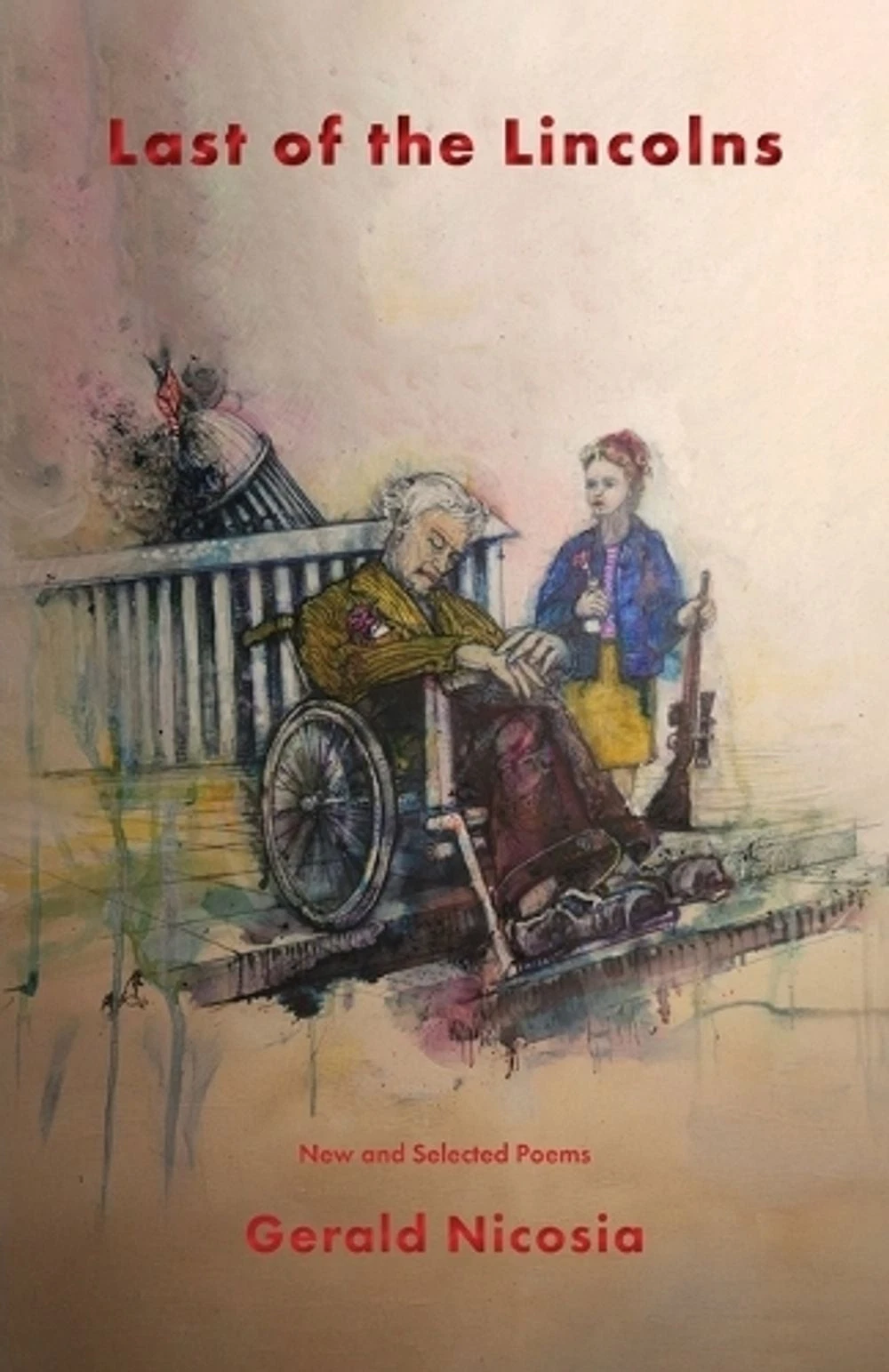
Last of the Lincolns
Iris Press, 2026
By Gerald Nicosia
Reviewed by Ryan Mathews
[Author’s note: Full disclosure, I know Gerald Nicosia well enough to call him Gerry. He has helped me on multiple projects. That said, I have not shown him this review or discussed it in any way with him. Who knows? I may be back to calling him Gerald after he reads this. I tell you this because review writers ought to be honest with review readers but rarely are. Bias goes with the territory. You have been warned. Now to business.]
Gerald Nicosia presents many faces to the world, all of them his own, but none of them captures the fullness of a complex individual. It’s probably a measure of a man who has never been known to walk away from a fight when he thought he was in the right, no matter how slim the odds of winning might be, that his supporters and friends tend to be as rabid as his critics and enemies.
Beatdom readers are perhaps most familiar with Nicosia as the author of the monumental and ground-breaking Memory Babe: A Critical Biography of Jack Kerouac which first appeared in 1983 and was significantly revised in 2022, and/or his other Kerouac- and Neal Cassady-related titles including One and Only: The Untold Story of On the Road and LuAnne Henderson, the Woman Who Started Jack Kerouac and Neal Cassady on Their Journey (2011), Jan Kerouac: A Life in Memory (2009), The Last Days of Jan Kerouac (2016), and Kerouac: The Last Quarter Century (2019).
A doubtless smaller group of readers for whom the War in Viet Nam is something more than just something they studied in American History or heard their grandparents talk about may also remember Nicosia from his decades of support, not for the war but for the men and women who fought it and returned home to a country that often shunned them. That support resulted in his other nonfiction epic, Home to War: A History of the Vietnam Veterans’ Movement (2001) and close, lifetime friendships with veterans including singer, songwriter, and musician Joe McDonald of Country Joe and the Fish fame and Ron Kovic, the activist and author of Born on the Fourth of July.
But let’s set aside the prose for a moment because Nicosia was a poet long before he was a Beat biographer or social commentator. Last of the Lincolns is, in fact, Nicosia’s seventh collection of poetry, containing selections from almost 50 years of work.
I’ve always admired the poetic inflections that Nicosia brings to his prose, the way he shapes language and image to tell a story. Last of the Lincolns illustrates how his technique works in reverse. The kind of simple, accessible, apparently straightforward language that can make prose so effective works here to invite readers to see the world through Nicosia’s eyes. But cave poetam!
Like all good writers Nicosia knows how to play with language, suggest things that are not there, conceal things that are.
Again, you have been warned.
“The Lincolns” refers to some of the roughly 2,800 or so American volunteers who formed the Abraham Lincoln Brigade that travelled to Spain between 1936 and 1938 to fight against the forces of General Francisco Franco, the Fascist leader backed by both Italian dictator Benito Mussolini and Germany’s Adolf Hitler.
At least 800 of them never made it home and many of those who did quickly found themselves under the scrutiny of a U.S. government that saw them as dangerous, subversive, Communist revolutionaries rather than the valiant first-wave frontline in an inevitable war with fascism.
Fortunately, time has been kinder to them.
“The Lincolns” have come down through history as idealistic, romantic young people who saw the threat of Nazism earlier than most Western political leaders, or at least sooner than those leaders would admit, and vowed to fight it even if it cost them their lives.
“Last of the Lincolns,” the final poem in the collection, details Nicosia’s observations during a gathering of a few of the Brigade’s survivors on February 27, 2005, at the Oakland Convention Center. Wondering what made them all leave their homes and risk their lives to defend a country that wasn’t theirs, he catches sight of an old veteran crossing the parking lot at the end of the ceremony who “toddles to / his old car / gets in / turns the key / in the ignition / and drives / away / still in charge / of his / own life / still a man / you can trust / to do / the right thing.”
The “Lincoln” is the archetypal Nicosian hero, the noble everyman warrior doing what he knows (not just believes) needs to be done, marching forward not for glory or recognition but because somebody has to do “the right thing.”
Over the years, “doing the right thing” by defending Jan Kerouac’s claims against her father’s literary estate has cost Nicosia personally and professionally. But that’s his story to tell another day, so let’s focus on the poetry he has brought us.
First of all, there is plenty for Beat fans to savor here—scattered references throughout the book and a whole dedicated section of 17 poems in “Kerouac and Other Beat Heroes,” which we’ll get back to in a minute.
Trust me.
I’ve been living with this book for a month now and I think it’s best to begin at the beginning and move along section by section, experiencing these poems in the order Nicosia presents them to us.
Angels of Sadness
The book’s first section, Angels of Sadness, is redolent with whispers of aging and mortality, acknowledged if not necessarily fully accepted.
Here are a few examples.
“The Things I’d Miss” seeks to order the importance of objects that will inevitably be left behind, such as a red glass lamp that conjures up a lost lover and, most importantly, his children who are both the poet’s past and future.
“On Turning 73” phlegmatically states that “Old age is not peace / It is a constant war to change / The limits on our human frame.”
Perhaps ironically for an author who wrote Memory Babe, in “Meditation on a Banal, Haunting Image from Life Magazine” warns us that “Even memory is false / Because memory is just like everything else / We hold on to / Comes the moment after / And simply to head for the flame / Of existence like / A suicidal moth / Knowing that our only hope is / To come through to the other side / Along with Jim Morrison and all / Our other dead friends.”
Beat and Beat-adjacent figures appear throughout this section from Steve Dalachinsky for whom “The Things I’d Miss” is dedicated to Ken Kesey who makes a guest appearance in “Poem for my Persimmon Tree and the Crows Who Visit It.” Jack Hirschman pops in “Scene in Spec’s” while Jack Kerouac is on hand to deliver the killer last line in “On Reading Some of the Dharma.”
If all this sounds depressing, it proves a point. Great, even good, poetry should be read directly and not parsed by a critic. But it also misses another, critical one.
Nicosia isn’t complaining about life as much as he is observing and even celebrating it when it is lived correctly, fully, and in the moment. Sure, when it comes the ending—whether at 26 like d.a. levy, 44 like Jan Kerouac, 47 like her father, or 101 like Lawrence Ferlinghetti—generally leaves something to be desired, but that’s all just part of the deal.
It’s a sentiment Nicosia puts more eloquently in the section’s final poem, “Death is a Gift Too,” written in June, 2004, which ends, “And then / In the emptiness and lostness / Of my total despair / As the waning sunlight slipped / Forever from my grasp / I realized / A truth that makes me happy / And satisfied / To this very minute: / The giving / Always / Redeems the dying.”
And there it is. That closing note of redemptive possibility. That sense that no matter how many others might see your battles as lost causes, no matter how deep the mud grows in the trenches of your mind, you always answer the bugle and charge forward into the fog of personal war because hope is only possible as long as you keep moving toward, ferociously embracing the righteous fight.
Wives, Mothers, and Daughters
Love—lost, found, and renewed—has been at the heart of many of the personal changes Nicosia has battled through over the past several years. There has been a divorce, a remarriage, an ongoing Kafkaesque battle with government officials to allow his wife Rosie to emigrate from the Philippines and join him here, all of which find their way into the section “Wives, Mothers, and Daughters.”
“Rosie,” the first poem in “Wives, Mothers, and Daughters,” is a paean to the poet’s wife, Rosie Andes Nicosia, to whom Last of the Lincolns is dedicated.
After a poetic inventory of all the things that allow him to get through each day—his ancient stained and crusty water boiling pot, radio, mailbox, notebooks, pens, etc.—he writes, “I couldn’t get through the day / Without each of them / But most of all / It’s your face / Your beautiful, incredibly / Beautiful, kind / Face / I need to / Lead me through the thorny, dark thickets / Of time / That I’d never make it through / Yet another day / Without the light of your eyes / To show my way …”
The less blissful and more litigious aspects of modern marriage are highlighted in “Marcy, This One’s For You,” addressed to his first wife. The message is far from subtle. “And there we are now, where future bored historians / Or dullard law students in need of a corpus delicti / Can find the footprints of everything that went wrong / But the things that went right have not died either / They’ve only gone underground / I kept trying to tell you that Love / Has nothing to do with the Law.”
“Poem for the Nights When I didn’t Say, ‘I Love You’,” dedicated to Marcia, explores the pain of love unspoken. “You’ll never know how many times I’ve kissed you / When you were not with me – / How many times I’ve said your name / When you were not near enough to hear it – / So much goes unsaid in love.”
“No poem of love will ever be complete –,” Nicosia observes, “Love’s greatness lies in incompletion – / We grow together like the lines in a poem / But when that poem has ended / The things that were not spoken are always / Those that mattered most.”
“Wives, Mothers, and Daughters” also contains two poems dedicated to his mother, Sylvia Anna Fremer Nicosia—the bittersweet remembrance written a little over a year after she dies, “Poem for My Mom,” in which Allen Ginsberg makes a cameo appearance, and the more soulful “Surprises,” which describes a visit to her in a declining old age.
There are also three poems dedicated to and about Nicosia’s daughter Amy, who began life in China as Wuji: “At the An Hui Provincial Museum,” “Poem for My Daughter Wu Ji on Her First Birthday,” and the emotionally powerful, personably-charged, gut-wrenching “Wuji Faces Her Birth Place.”
I won’t quote from “Wuji Faces Her Birth Place” here because, even more than other poems in “Last of the Lincolns,” anything less than a full reading will never do it justice.
Which brings us straight to the feet of the Beats and other fellow poetic travelers.
Kerouac and Other Beat Heroes
Beatdom readers may be tempted to jump right to the book’s third section, “Kerouac and Other Beat Heroes.” That would be a mistake.
First, consciously or otherwise, Nicosia arranged these poems to be read in the order they are presented. Next, as we’ve seen there are plenty of “Beat” references scattered throughout the preceding two sections to tide you through until the main event.
“Poem for Gregory Corso’s Ashes in the English Cemetery in Rome,” the first entry in the “Beat” section celebrates Corso’s gleeful bad-boy behaviors. Written when it seemed that Corso’s ashes might be evicted from Rome’s English Cemetery for nonpayment of rental fees, Nicosia begins: “Dear Gregory, as long as I knew you / They were throwing you out of places.”
Among those “places” were such San Francisco hipster institutions as City Lights Bookstore, the Vesuvio Café, and Dante’s Inferno. The poem ends with Nicosia imploring Corso to teach those who would evict him, “the biggest lesson of all […] That only the truly / And forever dead / Would dream of / Digging up / Someone who is still alive / Underground.”
“Poem For Neeli”is an homage to Nicosia’s friend, the late and universally beloved poet Neeli Cherkovski. “Guardian of the Heart” fulfills a poetic promise to his friend Eugene “Gene” Ruggles, the deep-image poet, activist, arts organizer, and longtime North Beach habitue. Ruggles died in 2004 at 68 in the third-floor room of the Petaluma Hotel he had occupied for 15 years. He died while in the process of being evicted from the Petaluma for nonpayment of rent.
Lawrence Ferlinghetti said, “Gene’s most outstanding characteristic is his heart. He really empathizes with the downtrodden and the down-and-out.” Nicosia calls Ruggles “our greatest bodhisattva.”
“Guardian of the Heart” is a celebration not just of Ruggles, or his life, but of his enduring spirit, vision, and “above all the passion he had / That this world be made right / Once and for all / And you knew in every word he said / And every poem he wrote / And every cause he stood up for / That he would not be satisfied / Till the work was done / And that he expected you / To carry it on / After he was gone.”
Unsurprisingly, the Kerouacs—père et fille—make multiple appearances in the section that bears their name.
In “The Ghost of Kerouac,” Nicosia speaks to the author of On the Road whose disembodied spirit has returned to his hometown. “You saw the future even before you died / And that’s why you always looked so sad,” he writes. “They can’t keep you out of Lowell / Because even ghosts / Have to have a home.”
This is another classic Nicosia poetic “tell”: the subtle use of everyday language to ask an unstated question. Is it Kerouac’s ghost that haunts Lowell or the ghost of Lowell that haunts Kerouac even beyond the grave?
More Lowell and more ghosts can be found in “Jack Kerouac Returns to Lowell After 25 Years.” Jack is united with the author of Leaves of Grass in “Graduating With Whitman.” “Did Whitman make Kerouac? / Did Kerouac make the hippies / Or did they both find something / That was hidden in plain sight,” Nicosia wonders. “Their answer,” he tells us, “is in / Every word they wrote / And didn’t write / But simply lived.”
The poetic spotlight then turns to Jan Kerouac, who traveled with more than her own share of ghosts.
“On the Way to Kerouac’s Funeral” is nothing more or less than a love song across time to Jan Kerouac. As in the case of “Wuji Faces Her Birth Place,” which we discussed earlier, the poem is so honest, so vulnerable, and so intimate that it deserves to be read as a piece, not as a series of selected lines.
John “Jack” Mueller, a fixture of the North Beach literary scene of the 1970s and 1980s, makes two appearances in “Remembering Jack Mueller (1942 – 2017)” and “Poem for Jack Mueller”: (who sings, “Don’t give me God / Don’t give me grammar”).
The poems reveal another critical element of Nicosia’s personality—loyalty that transcends the confines of the popular. Mueller’s work, especially his later material, was rapidly slipping into obscurity and might have made it except for the intervention of Lithic Books publisher Danny Rosen who kept Mueller’s work—including collections like Budada, The Gate, and QWERTY & Chicken Windows—in print.
Other Nicosia friends are here as well like John Mulligan, the author of Shopping Cart Soldier; poet editor Allen Cohen; Cleveland poet, publisher, and underground ‘zine revolutionary d.a. levy; jazz great Cecil Taylor; and the late poet and playwright Ntozake Shange whose biography is Nicosia’s current mega-project.
Two of my favorite poems in this section are devoted to Bob Kaufman, “The Man No One Hated,” and Jack Micheline, “For Jack.” It’s relatively easy to poetically praise Kaufman because… well… everyone did, in fact, love him, then and now that he has passed.
Micheline, however, could be a bit more of an acquired taste, a fact Nicosia readily admits opening with “Jack, you were an ornery cuss / I watched you piss off more people than I could count,” conceding, “you were sexist, chauvinist, anti-business / on the wrong side of everybody’s tracks / the most politically incorrect person / this side of Rush Limbaugh.” Nicosia adds: “but I swear I hardly ever knew anyone / with a bigger heart / or anyone who felt more the pain and beauty / of this strange experience we call life.”
Haiku
There are six haikus and one senryu in “Haiku,” the Last of the Lincolns’ penultimate section. Here we are reintroduced to characters who have made appearances earlier in the book such as Allen Ginsberg and Steve Dalachinsky and cameos by others including Lawrence Ferlinghetti and Antler.
Last of the Lincolns
The collection’s titular final section touches on a number of themes ranging from the ecological (“The Love Song of Earth’s Despoilers” and “Did Shakespeare Forsee Global Warming?”) to the overtly political (“Poem For Those Who Lifted Their Voices,” “St. Francis Walks the Streets of North Beach,” and “The New America”).
And what would a Nicosia collection be without a jaundiced look and a not-so-subtle poke at the literary establishment delivered here in “International PEN Congress Blues”?
Coda: What’s it all about, Gerry?
My review copy of Land of the Lincolns came with an inscription that read, in part, “Here are snapshots of my life.”
So there you have it.
This isn’t the full album or some poetic Apologia Pro Vita Sua. Nicosia isn’t signing off. This shouldn’t be looked at as some final statement. He’s just sharing these poems the way old friends might share conversation over a coffee at Caffe Trieste on Vallejo or a wine or beer at Vesuvio.
In Nicosia’s world there is always more to say, more stories to tell, more old friends to celebrate, and more old battles to refight. Like the real last of the Lincolns, Nicosia doesn’t much care if you remember his wars as long as you remember those he fought against and alongside.
As he put it in “Haiku for Steve Sanfield”: “So much to say / Three hours / Just the beginning.”


Great work with Review..I believe you convince me to purchase it..So, thanks for that