

UPDATE: Beatdom #26 is now on sale. You can buy it on Bookshop, Amazon, or Gumroad (as a PDF).
It is now just two weeks until the 100th anniversary of the birth of Allen Ginsberg. On that date, we will publish Beatdom #26: The Allen Ginsberg Centennial Special. It is by far our longest issue and I believe it is the best one yet. At 400 pages, it is more like an anthology than a typical literary journal, but we have stayed true to our traditional style of mixing essays and art, interviews and poetry, memoir and archival documents.
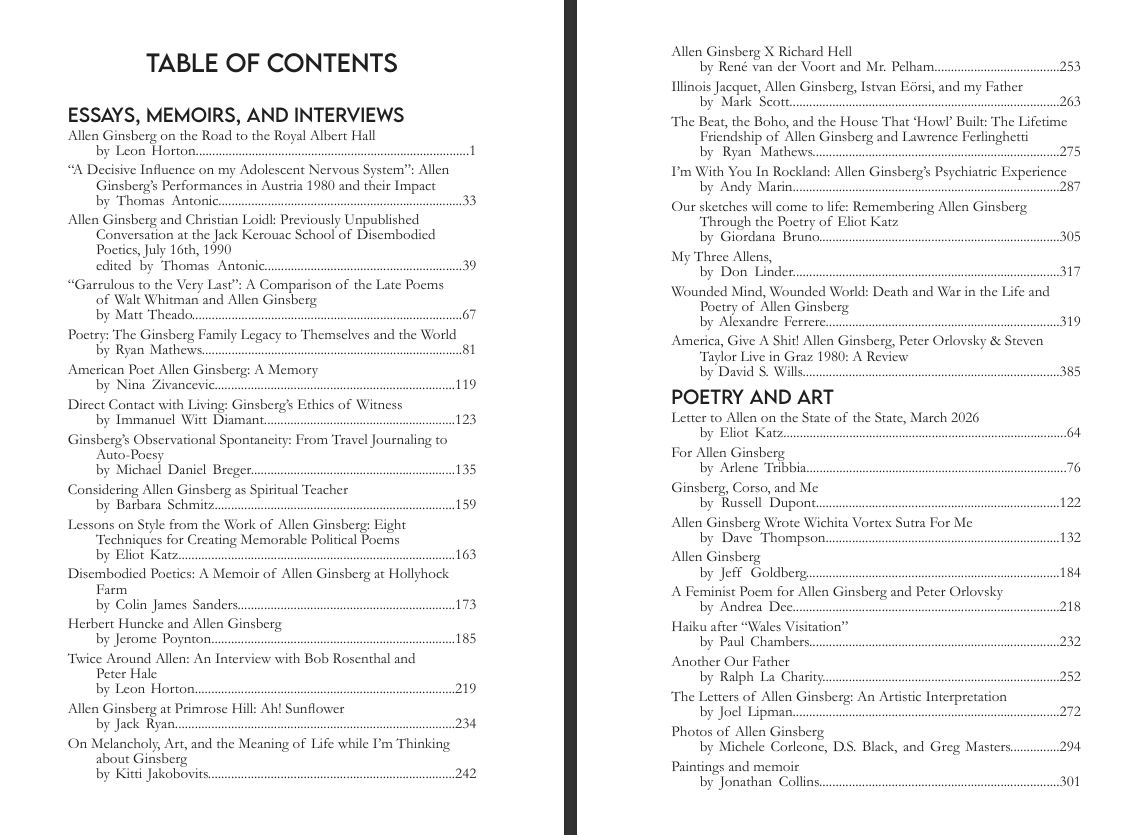
Here are the contents pages:
As you can see, it’s much longer than even our last few issues, which were themselves significantly longer than earlier ones. (This line graph shows page counts going back to Beatdom #9, which is when we switched to the current format of the journal.)
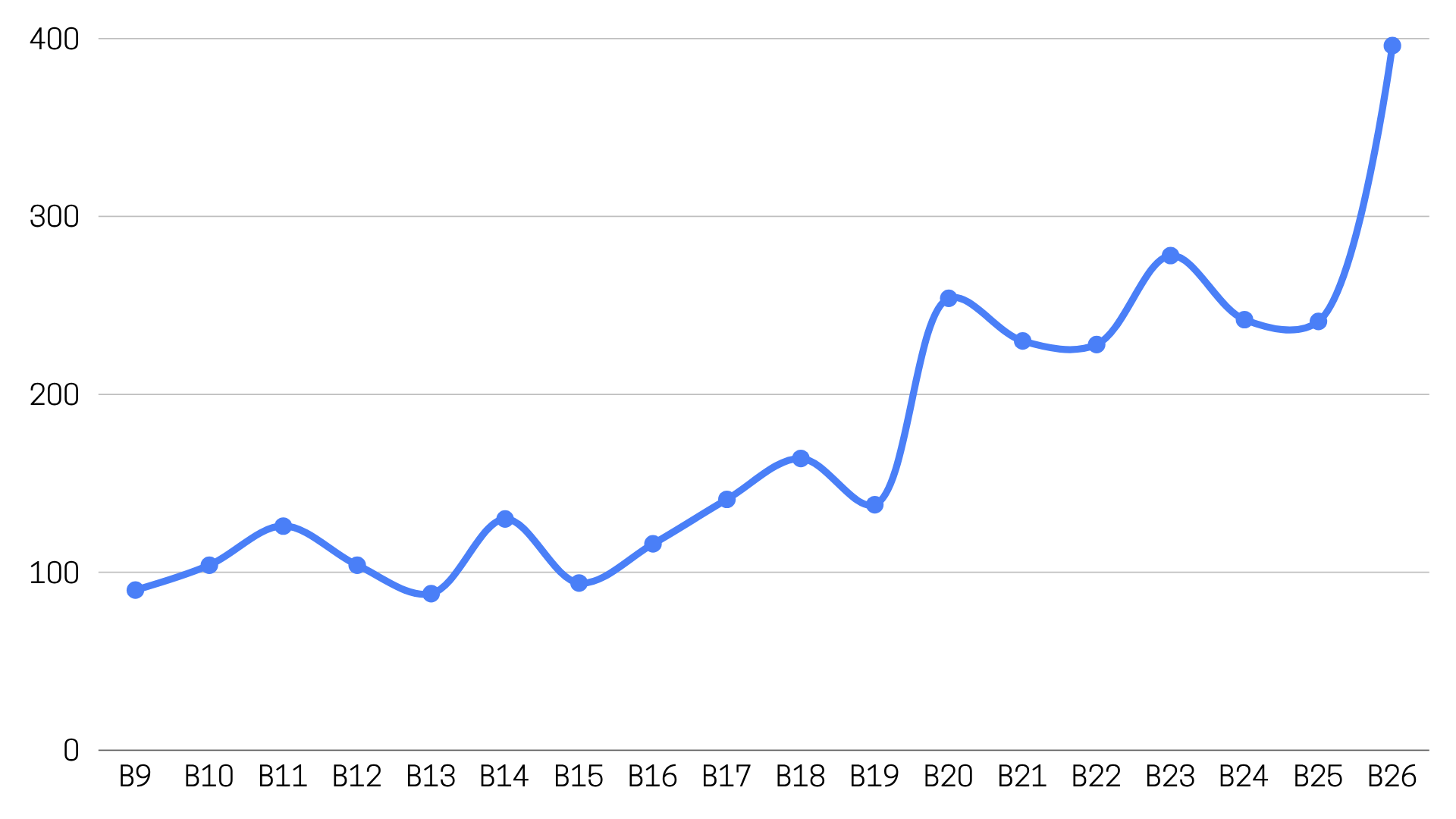
And that doesn’t even take into account the fact that we’ve dropped the font size, so the word count has more than doubled…
But of course, it’s not about the length of the journal. What matters is the quality of material, and we’ve gone for a huge range of topics and tried to stay away from that which has already been extensively discussed. We don’t need another essay on the importance of “Howl” right now; it’s more interesting to learn about the creation of auto-poesy. Instead of retelling the story of the Albert Hall reading, Leon Horton looks at the more or less ignored time Ginsberg spent in England before that event. These are just two examples of our intent here, which is to say providing original perspectives.
You can pre-order the journal here:

We will send out the first batch of pre-ordered copies in a few days, with the hope that they arrive on or before the anniversary (June 3). Note that people in the US and UK typically receive their copies before those abroad, due to shipping times. Later, we will add the journal to online retail websites like Bookshop.org and Amazon. We will also sell a PDF version through a pay-what-you-can-afford model. We would hate for anyone to miss out because they cannot afford a print copy. Discounts are also available for bulk purchases.
In early June, we will also publish Marc Olmsted’s Beat Dharma, which is a collection of his writings on Buddhism and the Beat Generation, as well as Thomas Antonic’s incredible investigative study, The Three Wives of Queer William S. Burroughs. There is an excerpt here.
You can see more of our forthcoming books here. This includes the next book by Bill Morgan.
Further Reading
With the journal already at 400 pages, I decided to not include my own contribution, a very long essay on the difficult relationship between Allen Ginsberg and Kenneth Rexroth. Instead, I posted that on Substack last month. It’s free to read and you don’t need to sign up (but doing so ensures you stay up to date with Beatdom).
It occurred to me that we have so many great essays on Ginsberg from the past few years that we probably could’ve put out a second book for the anniversary—a collection of essays. But why bother? They’re all free to read online anyway. Here are some highlights:
- “First Draft, Best Draft,” an essay which aims to (finally!) answer the question of when exactly “Howl” was first written.
- “Allen Ginsberg and NAMBLA,” an essay which explores that most unpleasant of topics. Thirty years after his death, his association with NAMBLA is still a stain on his legacy.
- “Senora in Xbalba,” a long exploration of the life of Karena Shields, the woman Ginsberg stayed with in Mexico prior to his time in San Francisco.
- “Allen Ginsberg in Southeast Asia.” Ginsberg’s time in India is well-documented, but this is the first serious look at his subsequent trip through Thailand, Vietnam, and Cambodia.
- “Mechanics and Poetics: William Carlos Williams and Allen Ginsberg.” Ginsberg was hugely influenced by Williams and this essay goes into immense detail on that subject.
- “Allen Ginsberg and the 1955 Arts Festival.” It is sometimes said that Ginsberg’s first poetry reading was at the 6 Gallery in October 1955, but he actually read 3 weeks earlier. This essay explores that and how it gave him the confidence to read “Howl” in public.
- “Dreaming, Howling, Naming.” In June 1955, Ginsberg awoke from a dream. He turned it into one famous poem but it is less well known that the process also sparked the writing of “Howl” and various other works.
- “Ginsberg’s First Poem.” A collection of archival documents from the early life of Allen Ginsberg, including his first published poem.
You can, of course, also just search “Ginsberg” on our main website or our Substack page to see more essays. The above are merely some ones that I think are of particular note and which are relatively recent.


