

In early March, a headline in the Community section of the Japan Times caught my eye:
Kyoto bids farewell to a storied poets’ café
The “poet’s café” was CC’s, in the Nakagyo Ward of Kyoto. The café was founded by American poet Cid Corman and his wife Shizumi Konishi, back in 1974. Since Corman’s death in 2004, the café had been run by Shimizu’s sister Sachiko and her husband. I’m not certain if Sachiko was still managing the business up to this year, but in any case, whoever was in charge opted to shutter the shop. The café had never been opened to produce significant profits—Corman saw it more as a gathering place than as an income generator. Its final day was February 28. The closure of CC’s is very much regarded as the end of an era. Since its opening, it had been a home away from home for members of the local poetry community, as well as a Mecca for visiting poets from around the world.
Back in 1951, before he moved to Japan, Corman established a poetry magazine called Origin: A Quarterly for the Creative. Origin printed work by poets who at the time were unable to get published anywhere else, many of whom went on to have long and storied careers. When Corman moved to Kyoto in 1958, he continued publishing Origin. Will Petersen served as co-editor. In addition to the quarterly journal, Corman also created Origin Press, a medium for publishing his own work as well as for a limited number of others. In 1959, Origin Press released Riprap, Gary Snyder’s first book. Corman had himself “designed the book in a traditional Japanese format: square-sewn with navy blue thread, what is properly called stab-sewn, with a white paste label.”[i]
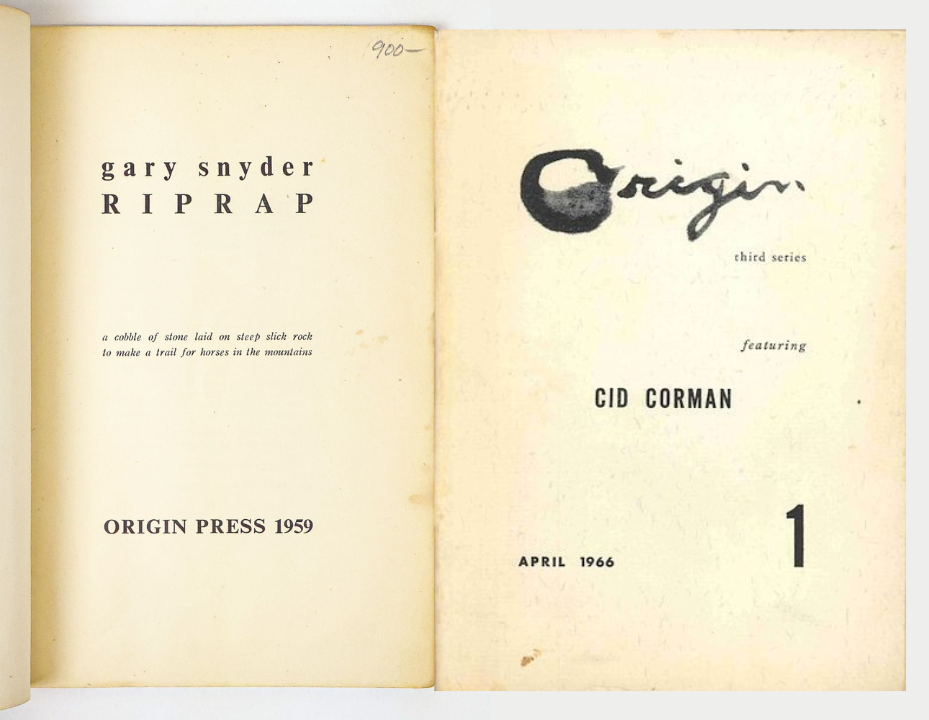
Corman and Snyder worked together to pack copies of the books into bundles. The bundles were then “tied with frayed yellow hemp-twine—the only other use I’ve seen for this material is securing Christmas trees or building supplies on the roofs of cars. Red wax seals were applied to the knots at the Japanese post office. Sent by sea mail, these copies would take more than six weeks to reach their destination: City Lights Books / 261 Columbus Avenue / San Francisco 11, California”[ii]
By one account, it was Snyder who assisted Corman in getting a position teaching English in Kyoto as a means of getting established in the city. His journal from March 1959 mentions Corman on three occasions. This was during Snyder’s second stay in Japan and the journal outlines the early days of this second venture. His first stay was from May 1956 to August 1957. By the time of Corman’s arrival in Kyoto, Snyder was an old Japan hand and in a position to be of some assistance to Corman.
24. III.1959
Cid Corman tearing into much of Myths and Texts, it isn’t “real” he says of “Io” and other borrowings from Occidental sources.[1] The Native-American-derived stuff he thinks makes it. Digs the concrete and directly experienced portions — finds the language not compressed or sharp enough often. He’s a very scrupulous critic but not always right.
28. III. 1959 Saturday Yase
— Living at Yase. Sunlight from over Hiei; rice cooking in the kamado and kai on the konro. The house feels too big and the road is terrible dusty; perhaps I won’t be able to make it here. But will see. Yesterday Pete brought Glen Grosjean out — looking young, chapped, red-faced, & more relaxed. He is moving to a new job up at Sendai — says he couldn’t do decent sanzen with his roshi because he didn’t respect him. Only stayed till 11 am. Afternoon Corman came — we climbed the hill in back, talking poetry as we crashed through the underbrush.
12. IV. 1959 Sunday
Today at Kawamura Nogakudo, with Ami and Will Petersen, Corman. Program was Tadanori, Uneme, Sumidagawa, Kantan. Sumidagawa gets absolutely hair-raising when the kokata (this time actually a little girl of four) quavers out “Namu amida butsu” from the tomb. The whole of Kantan is superb. And riding home at night in April rain. Soaking wet.[iii]
I have heard that Allen Ginsberg visited Corman at CC’s, but I can find no specific documentation on the meeting. Ginsberg was in Kyoto in July of 1963 (where he took photos of Corman) and again in 1988, so it is certainly possible; however, Corman and Ginsberg were said to have had a volatile relationship that spanned several decades. Corman wrote a poem to Ginsberg at one point that appears to reflect that volatility:
To One of The Good Ones
Allen – there’s only
your word for you. What
I – as a fellowpoet – can append
is a thank you for
having been kind toso many others –
even if not to
me – Little enoughto go around . Once
life – but the one death’s
life to celebrate.
Ginsberg mentions Corman in this dialogue with Philip Whalen from 1976 but says little except that he knew of Origins. However, Whalen mentions knowing him and Corman making an effort to get a book published.
Whalen lived in Japan in the late sixties and early seventies and was a close friend of Corman’s. In his poem “‘Severence Pay’ (Whalen),”Corman refers to Whalen as “My next-door neighbor and friend,” and goes on to say, “Phil is the comedian who always cries at his own jokes.” Firmly establishing their Japan connection, Corman continues in the same poem:
Playing Bach for himself and the passing neighbors, shrieking at the mongrel cats who bring in dirt while he vacuums the tatami or cursing the cat that bites (gratuitously) the foot of one who often does the feeding, the doors back and front open—letting the air flow through—at almost any hour. The cleanliness, the thoughtfulness, the daintiness of a bear of a man, beard of a man, who relishes whatever it is that it is to be….[iv]
One poet associated with the Beats (although he firmly rejected the title “Godfather of the Beats” thrust upon him by Time magazine) had a less than enthusiastic impression of CC’s Café. Kenneth Rexroth visited Japan a number of times. During a 1975 visit, he resided in the Higashiyama district of Kyoto. Although I found no direct references to Rexroth visiting Corman at CC’s, he certainly had opinions about the place. In a series of letters written to his friend and fellow poet Morgan Gibson, Rexroth paints a picture of CC’s as a place to be avoided:
June 14, 1975
There are all sorts of coffee shops in Osaka, Kobe, Kyoto where you can meet girls. The best for you is Honyarado near Doshisha University in Kyoto. Stay away from gaijin [foreigners]. It’s like West Berlin. 50% are CIA. Avoid “Jitoku” and even Cid Corman’s “CC’s.” Associate with Japanese as much as possible. Forget “sitting” [zazen] at Daitokuji, etc. They – the mystical gaijin – are all “freeks” as Dianne [Jarreau] calls such people in the Inscrutable Orient.
July 31, 1975
Corman’s coffee shop & ice cream parlor is a hangout for gaijin & gaijin lovers. Jitoku is worse. Katagiri’s brother runs a coffee shop Honyarado which is better – but all these places crawl with freaks & CIA – usually the same people. My advice to you is to associate as much as possible with ordinary Japanese people in Japanese places.
February 1, 1976
I do hope you keep out of Jitoku & CC’s and gaijin stews and make some good Japanese friends.
February 1, 1977
Dear Morgan – You are a caution! There are plenty of girls around Cid Corman’s & Honyarado just dying to meet gaijin poets etc. If [you] fail you can buy an inflatable woman from any sex shop. They invented them. Kobe variety is world famous…[v]
Nevertheless, although Rexroth did not approve of the man’s café, he did appear to respect the man himself—or at least his place in American poetry. When asked who was responsible for the turnabout in the direction of US post-war poetry, Rexroth responded:
Cid Corman, Robert Creeley, Jonathan Williams, Richard Emerson and their magazines Origin, Black Mountain Review, Jargon, Golden Goose laid the foundations for a new, minor Renaissance in American verse.[vi]
Cid Corman is not considered a Beat poet, but he certainly had influence on several artists of the Beat Generation. He was a supporter of many of them and a mentor to some. His name has been associated with several literary movements—the Black Mountain poets and the Objectivist movement dating from the 1930s, along with the Beats. But Corman considered himself a standalone resource. His realm was poetry—all poetry, and he readily accepted any serious student of the art. His willingness to talk about poetry was legendary and his own poetic output was prodigious. Corman said he could easily produce a small book of poems in a single day.
With some interruptions, Origin was issued on a quarterly basis from 1951 to 1985. The pauses in publication were due to Corman’s bouncing between Japan and several US locations, including three in his native Massachusetts (Dorchester, Boston, Ashland) as well as Orono, Maine. The issues published in Japan occurred in two series: 14 issues from April 1961 to July 1964 and 20 issues from April 1966 to 1971. Once established in Kyoto, Origin served as a link between the poetry communities of Japan and the United States.
Corman was committed to publishing innovative poetry from around the world. This included some works printed in translation, with Corman doing the translation not only from Japanese, but also Chinese, Italian and French. Each issue of Origin included letters from readers and occasional essays on poetry and art.
During my years in Japan, I lived in a city west of Kyoto, further down the main island of Honshu, about a two-hour ride away from Kyoto via the Shinkansen bullet train. To be honest, I only ventured up to Kyoto when we had out-of-country visitors who insisted on going. I found the place to be hopelessly overloaded with tourists back in the early 90s and I can’t imagine what it’s like now. Like Corman, I first ventured into Japan via an English teaching post. While teaching, I wrote an occasional essay for an Okayama magazine—very abbreviated, it was just enough to allow me to consider myself a writer. I was aware of CC’s but never did seize the opportunity to visit the café when there in Kyoto.
In fact, I only resurrected my memories of Cid Corman about three years ago, while doing research for my first novel. It was going to be an American-on-the-road story (the road being railroad, i.e. freight trains) in this case. Above and beyond that, my plan was to include haiku from Matsuo Basho’s Oku No Hosomichi (Narrow Road to a Far Province) at intervals during the story, with Basho’s imagery reflecting some of the scenes portrayed in my narrative. My wife had agreed to provide calligraphy for the opening and closing haiku.
The haiku would be in English translation, although I did end up including the Japanese version in Romanized (romaji) format along with the English. For the English translations, I planned to cherry pick the best of what I found through studying various versions that have been published over the years. Over the many years in this case. Basho died in 1694. His own on-the-road adventure (or at any rate what turned out to be his last completed journey) took place in 1689.
One translation that did pop up early in my investigations was Cid Corman’s. Titled Backroads to Far Towns, I felt this choice of title had a colloquial warmth that wasn’t reflected in other translations. Corman was aided in the translation by Kamaike Susumu, and the narrative is accompanied by sumi-e drawings by Hide Oshiro.
It’s been reported that Cid Corman spoke very little Japanese himself but appeared to have a knack for translating both Chinese and Japanese poetry into English. (This is also said to be true of Rexroth.) Corman’s own poetry has been described as having an Oriental flavor, economic in style and seen as reflecting a Zen Buddhist influence. My own perspective on Corman’s work is that it manages to establish an exacting point of view, from which he is then able to launch his own minute observations. Rexroth offered his own assessment of Corman’s translation of Basho:
Corman adopts an extraordinary language, bearing some resemblance to his own poetry and those poets associated with his magazine Origin. It does not mimic Japanese syntax but it does try to mimic Basho’s own psychological syntax and the tone of a decoratively scrawled notebook. Corman’s haiku are something else—Zen mondos with a vengeance.[vii]
I found Corman’s to be the most literal of all the translations of Basho that I surveyed. I am not fluent in Japanese but having spent considerable time in country and studied the language and culture, for something as limited in scope as the three lines of a haiku, I can devote sufficient focus to parse the meanings involved. And in any case, concerning my exact level of Japanese I usually inform people that “I’m fluent – unless my wife is in the room!”
My novel was self-published in the fall of 2024 and did include snippets of the Corman translation here and there. My other sources for translations included Dorothy Britton and Donald Keene. I ended up having far more of Britton and Keene than Corman in the haiku that accompany my narrative, but I do have to give due credit to Cid Corman for providing the most inspiration. His versions of the haiku simply feel more authentic. Between his phrasing and the sumi-e drawings of Hide Oshiro, you feel immersed in Basho’s time and place when you stroll down those Backroads to Far Towns.
And now at this point in my writing career, Cid Corman, resource for poets worldwide, including the Beats, has become a valued resource for me on my own literary journey. I truly wish I had been able to visit CC’s Café before it closed.
how inspiriting
the green leaves young leaves of a
sun’s resplendency
Matsuo Basho
April 1, 1689
(Corman/Susumu trans.)[viii]
[1] Myths & Texts was the just-published book of poems by Snyder. Petersen designed the cover for it.
[i] Jack Shoemaker; Gary Snyder’s Riprap and the Community of Letters
[ii] Jack Shoemaker; Gary Snyder’s Riprap and the Community of Letters
[iii] Of All the Wild Sakura: The Journals of Gary Snyder – Kyoto Journal
[iv] At Their Word: Essays on the Arts of Language, Vol. II; Black Sparrow Press, 1978, pp. 151-54.
[v] Morgan Gibson; Revolutionary Rexroth: Poet of East West Wisdom; Rexroth’s Letters to Gibson (1957-79)
[vi] Samuel B. Garren; The Influence of Kenneth Rexroth’s Bird in the Bush and Assays on North American Poetry in the 1960s
[vii] Bureau of Public Secrets, PO Box 1044, Berkeley CA 94701, USA; (bopsecrets.org)
[viii] Cid Corman, Kamaike Susumu; Backroads to Far Towns – Basho’s Travel Journal; White Pine Press


