In the winter of 1971, I was struggling mightily through a course entitled “Survey of Western Literature.” In the same semester, I was taking another course, “Western Civilization: Its Genesis and Destiny.” There was no shortage of mighty undertakings in my freshman year at Harpur College, which at that time was rapidly morphing into the State University of New York at Binghamton (SUNY), and is now named, much more straightforwardly, Binghamton University.
The Western Lit course was indeed daunting, but I had somehow managed to keep up with the reading. It included Dostoevsky’s Crime and Punishment, Turgenev’s Fathers and Sons, Fitzgerald’s The Great Gatsby, and Hemingway’s The Sun Also Rises, among others. The class was taught by a trio of professors from the very strong “Department of English, General Literature and Rhetoric” at the school. One member of the trio was a noted Joyce scholar, and I’m still relieved he assigned us Portrait of the Artist as a Young Man rather than Ulysses.
As we neared the end of the course, and the snow had turned to mud across our perpetually windswept campus, the trio announced the assignment of the final book of the course. The Joyce scholar proclaimed it as a “nice change of pace.” The other two professors just smiled.
The book was Lucky Jim, by Kingsley Amis. And I truly loved it. For one thing, it was mercifully short. As I recall, we had been given only a week to read Crime and Punishment, and Lucky Jim weighed in at well less than a third of that. For another, it was light. Light in tone as well as volume, it portrays the struggles of a professor of Medieval History at an English university. It was also funny—refreshingly funny following all the heavy tomes that had preceded it in the class, but also funny enough that I’ve read it every few years since then and have experienced the same positive reaction each time I open the story. Over the ensuing years, I became a Kingsley Amis fan and have read most of his books.
Three years later, I left SUNY B and headed west, ending up in Oregon. Post graduation, I was finally able to read for pleasure and dove into a book that many of my friends had been talking about throughout my college years: On the Road. I immediately loved it, and it was with no little satisfaction that I discovered that I had traced some of the paths that Sal Paradise had encountered on my own journey west, all without knowing the story. And so I became a Jack Kerouac fan. However, unlike my studies of Kingsley Amis, which have now covered most of his books, in the pursuit of Jack Kerouac I simply read On the Road over and over again. Essentially, as often as I read Lucky Jim.
It is only now, after more than 50 years of loyalty to these two books, that I have seriously begun to wonder why they’ve each impacted me so. What do the two books have in common? Could it be that the authors as well might have some connection that I’ve been unaware of? My initial thoughts ran along the lines of: Did they ever meet? If they didn’t actually meet, were they aware of each other’s work? Could they even be considered contemporaries? (They were certainly alive at the same time, but I had the impression that Kingsley Amis was older.)
I approached the contemporaries question first. That was the easy part. Kingsley Amis was born in Clapham, England, on April 16, 1922. Jack Kerouac was born in Lowell, MA, on March 12, 1922. So much for my impression of Amis’ seniority—he was junior to Kerouac by a full 36 days.
That brought me to the question of whether they had ever met. And they indeed had—on one rather tumultuous occasion. In November of 1958, the Brandeis University Club of New York hosted a panel discussion on the topic, “Is There a Beat Generation?” Four speakers were invited. They were James Wechsler, editor of the New York Post; Dr. Ashley Montagu, a Princeton University anthropologist; Kingsley Amis, described as a graduate of Oxford University and current lecturer at Princeton; and Jack Kerouac, in his role as the purported leader of the Beat Generation.
The discussion was held in the Playhouse of Hunter College in Manhattan, on the evening of November 6, 1958. Fortunately, the event was audio recorded for posterity—at least most of it was. Some of the interactions that immediately followed the speakers occurred after the taping ended.
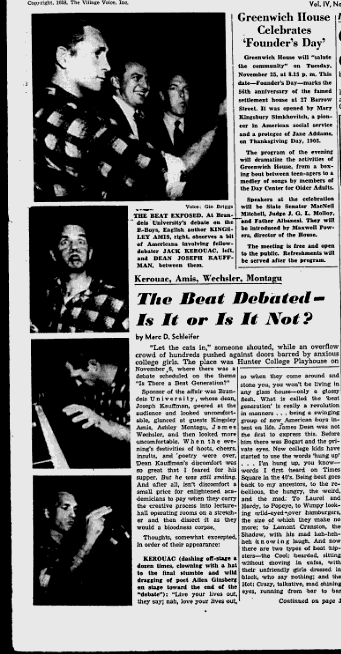
The moderator for the discussion was Joseph Kaufman, Dean of Students at Brandeis. Along with the audio tape, the event was covered by the Village Voice, which sent reporter Marc D. Schleifer, accompanied by photographer Gin Briggs. By the time the evening of the event arrived, Kaufman may have begun having a few misgivings about volunteering for the mission.
Attendees described the scene as frenetic. In the opening of his article on the event, published in the November 19th edition of the Village Voice, Schleifer offers a glimpse of the scene:
“Let the cats in,” someone shouted, while an overflow crowd of hundreds pushed against doors barred by anxious college girls.[i]
New York Post editor James Weshler later recorded his recollections of the event in his book, Reflections of an Angry Middle-Aged Editor, in a chapter pointedly titled “The Age of Unthink”:
My first astonishment was the size of the audience. As one apparently addicted to public speech since an early age, I have grown accustomed to addressing empty seats as well as uplifted drowsy countenances. I had steeled myself for the sight of unoccupied leather. Instead, on arrival at the entrance, I discovered that this was what is known in the trade as an SRO affair, with scores of young people milling around outside the auditorium in the vain hope that the capacity of the hall would be expanded by the rhetoric inside.
The audience was predominantly, if not exclusively, young—ranging from high-school students to college seniors, and with a sprinkling of the middle-aged and the old. With due reverence for Messrs. Amis, Montagu and myself, a large proportion of those present had obviously come to see and hear Kerouac, which, after all, explained my own belated presence too. There were, also, no doubt some who had just come for the show.
I cannot recall as large an assemblage of young people except for the captive audiences of school assemblies—since the radical heyday of the thirties. The Beat, of course, do not carry membership cards and one has no way of knowing how many true disciples were recruited or disaffected by Kerouac’s chaotic exhibition. But the size of the turnout was extraordinary.’[ii]
Once inside the Playhouse, Schleifer and Weshler each offer additional observations. From the Village Voice article:
Sponsor of the event was Brandeis University, whose dean, Joseph Kaufman, peered at audience and looked uncomfortable, glanced at guests Kingsley Amis, Ashley Montagu, James Weshler, and then looked more uncomfortable.[iii]
And continuing from James Weshler’s recollections:
On the evening of November 6, 1958, I took part in a symposium on the Beat Generation at Hunter College. The event, if it may be so described, was sponsored by Brandeis University; the other participants were Jack Kerouac, author of On the Road and self-proclaimed voice of the Beat Generation; Kingsley Amis, the talented, witty British writer who admits to being neither young nor angry but has been so labeled on two continents; and Professor Ashley Montagu, the noted anthropologist.
As I walked a trifle uncomfortably down the center aisle to the stage, I got my first view of the leader of the Beat Generation. He was attired in a lumberjack shirt unadorned by tie, but there was nothing especially ostentatious about his lack of dress. A little more flabbergasting was the discovery that he was holding what proved to be a glass of brandy, and throughout the evening he made several trips to the wings for a refill. Kerouac acknowledged my arrival by observing, “You ruined my sentence,” and then resumed a discourse which I am obliged to describe as a stream of semiconsciousness.[iv]
Dean Kaufman kicked off the event with a statement of the topic to be discussed and a brief introduction of the first speaker. He spoke slowly and deliberately, with pauses between each sentence:
I want to bid you good evening and welcome to the second in the lecture series presented by the Brandeis University Club of New York. And I first of all introduce myself, Joseph Kaufman, dean of students at Brandeis University. The subject for tonight’s discussion: Is there a Beat Generation? It is the subject of considerable interest on many college campuses, particularly urban universities. It is of literary interest, of interest as a social phenomenon—and some would consider as a symptom of the alienation which many young people experience in trying to adapt to the standards and the problems of our society in this anxious age. My role will be that of chairman or moderator, and since we have gifted spokesmen on the program I will only intrude when it becomes necessary. [Brief laughter] Is there a Beat Generation? Our first speaker is a man who has been called the spokesman of the Beat Generation, although it is my understanding that he dislikes this title. He is a native of Lowell Massachusetts, a former student at Columbia University, author of numerous articles and books, including The Town and the City, On the Road, Subterraneans… and most recently, The Dharma Bums. I’m pleased to present Mr. Jack Kerouac.[v]
After brief applause following Dean Kaufman’s remarks, Kerouac appeared onstage and began speaking:
The question is very silly because we should be wondering tonight, “is there a world?” But I can go and talk to five ten twenty minutes about is there a world because there is really no world because sometimes I’m walking on the ground and I see right through the ground and there is no world. And you find out. But they asked me to write an article about the Beat Generation and it fits right in with the question of the Dean. It’s called The Beat generation and it’s—the article’s supposed to be about my relationship to the Beat Generation and all that stuff. It’s a very funny article… So… I never made a speech, so I’ll read it…[vi]
As he indicated, Kerouac had notes with some prepared remarks but did not strictly adhere to them in his wide-ranging presentation. As to the manner in which he delivered his statements, again Schleifer and Weshler provide some context. From the Village Voice article:
KEROUAC (dashing off-stage a dozen times, clowning with a hat to the final stumble and wild dragging of poet Allen Ginsberg on stage toward the end of the “debate”).[vii]
And from Weshler’s book:
Kerouac is dark-haired and sturdily built (he played football for a year for Lou Little at Columbia and, when he quit, the coach said prophetically that the “boy was tired”). He has rather graceful gestures; he alternates murmurs of flirtive sexuality with intimations of high piety. He deftly evokes the emotional loyalty of those who feel that they too, are Beat. It is no irreverence, I trust, to say that at moments he might have been called the Billy Gloomy-Sunday of our time.
There were times when he sounded like a jaded traveling salesman telling obscene bedtime stories to the young; there were others when the melancholy of his cadences achieved a mildly hypnotic effect, so that one listened to it as if hearing an obscure but appealing fragment of music. There were also many intervals that can only be described as gibberish.
I find little rhyme or reason in these observations, and the Leader drooped to the dimensions of ham. The totality of his performance, brightened as it was by flashes of imagery, was a union of madness and sadness; by the end the occasional vivid or moving phrase seemed like an isolated line of poetry surrounded by vulgar ramblings on a latrine wall.[viii]
From the audio recording of the event, I can attest to the wide range of voice modulation that Kerouac employed in his presentation. When he launched into his notes for the prepared portion of his remarks, he adopted what I characterize as a down-home country bumpkin style of speaking:
This article necessarily have to be about myself and going all out. That wild eager picture of me on the cover of On the Road results in the fact that I had just gotten down from a high mountain where I’d been for two months completely alone. And usually I was in the habit of combing my hair of course, because you have to get rides on the highway and all that… usually want girls to look at you as though you were a man, not a wild beast…[ix]
But he then shifted entirely into imitation mode when he described his recent interview with Ben Hecht:
Recently, Ben Hecht said to me on T.V., “Why are you afraid to speak out your mind? What’s wrong in this country? What is everybody afraid of?” [Laughter at JK’s imitation of Hecht] Was he talking to me?! And all he wanted me to do was to speak out my mind against people. He sneeringly brought up Dulles, Eisenhower, the Pope… all kinds of people like that… habitually that he would sneer at with Drew Pearson. Against the world he wanted… This is his idea of freedom. But who knows, my God, but the universe is not one vast sea of compassion actually… the veritable holy honey, beneath all this show of personality and cruelty. In fact, who knows but that it isn’t the solitude of the oneness of the essence of everything. Comma. The solitude of the actual oneness of the unborn-ness of the unborn essence of everything. Comma.’[x]
Kerouac occasionally threw out the word “Comma” with great emphasis, readily acknowledging to the audience the fact that his statements were being delivered in a non-stop/non-pause mode entirely free of punctuation. I added punctuation to his quotes as I listened to the audio—simply for my own orientation.
Despite a good deal of wandering and digression, including a poem dedicated to Harpo Marx, Kerouac did at one point actually address the subject of the session:
Why should I attack what I love out of life? This is Beat. Live your life out?! Nah! Love your life out! And when they come and stone you, at least you won’t have a glass house… just your glassy flesh. [Laughter] But that wild eager picture of me on cover of the book On the Road where I look so Beat… goes back much further than 1948 when John Clellon Holmes, author of Go and The Horn (good book, The Horn) and I… was sitting around trying to think up the meaning of the Lost Generation subsequent existentialism. And I said, “You know John, this is really a Beat Generation,” and he leapt up and said, “That’s it, that’s right!” Maybe since I’m supposed to be the spokesman of the Beat Generation… I am only the originator of the term, and around at the time of the generation taking shape.[xi]
Kerouac then wandered away from the subject of the Beat Generation entirely into a somewhat lyrical description of growing up in New England, along with his Breton ancestry, and finally closing with another poem. At the conclusion of Kerouac’s remarks, Dean Kaufman uttered a “Thank you, Jack Kerouac” in a somewhat subdued voice that was supported by a few chuckles from the audience. He then added, “Three other speakers will address themselves to this topic.” He seemed to rally as he moved on to introduce the next speaker:
Our next speaker was born in London England, educated at Oxford University, is considered the novelist spokesman for England’s Angry Young Men, another appellation. Author of Lucky Jim, among other publications, and presently a visiting fellow with the rank of lecturer at Princeton University and its creative writing program. I am very pleased to present Mr. Kingsley Amis.[xii]
Marc Schleifer described the introduction in his article:
KINGSLEY AMIS (author of “Lucky Jim,” wearing a conservative light-brown suit, perplexed by the mad audience, but in a friendly way, trying to understand the madness).[xiii]
In a bit of an understatement, Amis opened with this observation: “Hello, ladies and gentlemen, it’s a very difficult task to follow Mr. Kerouac.” This was greeted with polite and understanding laughter. But he then immediately addressed the stated subject of the symposium:
I take it that my main function here, if I have one at all, is to bring you news from England, where there’s a good deal of curiosity about America’s Beat Generation; both as a literary movement, if it is that, and a social phenomenon and emergent group and psychological novelty, if it’s any of those.
The British don’t know their way around this thing and to that extent I’m typically British and so I hope to learn something tonight—I’ve already learnt something. [Laughter] As well as, if possible, imparting something.[xiv]
As Jack Kerouac was almost universally identified as a member, if not the leader, of the Beat Generation, Amis was similarly labeled as being part of the Angry Young Men literary movement in the UK. Amis spent a significant portion of his remarks addressing this categorization. He stated emphatically that such classifications were the product of a collection of “literary middlemen”:
It’s characteristic of the journalistic approach to put people in pigeonholes and save the reader trouble and exertion. It’s easier to have novels and plays pre-digested than to face the grueling task of making up one’s own mind about them. Because works of art have an annoying habit of being different from one another. And requiring a fresh effort every time you start on one. How much more comfortable to find out in advance that a whole lot of them are really all the same… they’re all Angry or Beat or something or other.[xv]
Amis then makes a statement in general about writers, whether labeled Beat or Angry or anything else:
And all these people, good and bad, are doing what writers have always done. And this is what it says here anyway… [Refers to notes] This is what I thought might be applicable to the Beat Generation as well. They’re all working as best they can in their own way, and if their work is to have any value it will have the kind of value that imaginative writing has always had… as a series of statements about human character and human relations. Of course, the background’s contemporary within it. Can’t be and can’t afford to be anything else. If characters wear checked shirts and jeans, this tells us something about them, whatever it may say about a check shirt and jeans ethos or way of life or outlook or ideal or neurosis or generation is entirely secondary. This is the right way to look at things, and it seems pretty obviously that to me…[xvi]
Amis was to be the only one of the panel members who addressed Beat writing, as well as the existence or non-existence of the Beat Generation. Just as he rejected the existence of an Angry Young Men literary movement in England, he took the same position regarding the US:
A label can be put up with while it’s merely inaccurate. The time to throw it away is when it’s so all inclusive as to be meaningless. There is no Angry Young Man movement. There may conceivably be a Beat Generation, but I very much doubt it.[xvii]
Amis’ statements were followed by a full 20 seconds of applause. As that subsided, Dean Kaufman returned to the stage:
Thank you very much Kingsley Amis. Our third speaker is editor of The New York Post and has been since 1949, is a graduate of Columbia University where he was editor of the Columbia Spectator, former editor of The Nation, author of numerous articles and books including Revolt on the Campus, Labor Baron and Age of Suspicion. He has also addressed the senior class at Brandeis within the last two years. I am pleased to present Mr. James Wechsler.[xviii]
Marc Schleifer described the transition in his article:
JAMES WECHSLER (editor of the New York Post and author of “Revolt on the Campus,” looking angry if not young, vigorously chewing his gum with open-mouthed liberal sincerity, staring at Kerouac with incomprehension whenever Jack mentioned God, Poetry, or the Cross).[xix]
Again based on the audio recording of the event, I would describe Weshler’s speaking style as pontificating. Not in a loud, pointed, “in your face” manner, but quietly, consistently condescending:
I’m in this symposium because, I guess that I am one of the few unreconstructed radicals of my generation. And much of what has happened in the last twenty, twenty-five years has challenged many of the things that I believe in deeply. And yet on the other hand my basic sense about what I care about in the world, what I fight for, what I believe in, is remarkably unaltered. I have to say to you that, with due respect to Mr. Kerouac [Turning to Kerouac], that I see no really major point in the kind of organized confusionism. Life is complicated enough without trying to make it a poem. [Light applause]
And I guess I think that it is a sad thing about America now, but that what is regarded as the Great Revolt and the great representation of dissent and unorthodoxy is what is called the Beat Generation. Because I guess it has very little meaning to me, and after listening to its spokesman tonight, I must say that I find myself groping in the darkest confusion as to what the hell this is about. [Laughter, Applause] There is the right for, thank God for all of us, to scream and shout and do anything we damn please in public. There is also, I think, the responsibility for us to try to give to the people in our society some sense of what matters and what is important and what we care about.[xx]
Weshler stated to the audience that the two greatest issues facing society were “the hydrogen bomb, which can caricature and make a mockery of anything that we call civilization, and the other is the quest for human equality.” He then offered his conclusion on the topic of the evening’s event:
I think that the Beat Generation as a symbol is, if I may say so with due reverence to its partisans in the audience, is sort of a joke. And the issue is not whether there is a Beat Generation, but whether there is a civilization that will survive the next decade. And I think that a minimum of responsibility and human intelligence requires that we would face that. It is just too easy to run away from the world. If my children were here, I would urge them to recognize that there is no valor involved in that kind of flight. Thank you. [Applause for 25 seconds, some cheers] [xxi]
After the lengthy applause, which turned out to be the longest of the evening until the conclusion of the event, Dean Kaufman returned:
Our final speaker is an eminent social scientist, an anthropologist, was born and educated in England, came to the United States in 1927, received his doctorate at Columbia University. He’s served in many academic capacities, including chairman of the anthropology department at Rutgers University. Has been known as an expert on the subject of race and was instrumental in the preparation of the classic UNESCO statement on race a number of years ago. He’s the writer of numerous articles both popular and scholarly, and author of The Fallacy of Race, The Natural Superiority of Women, and Man, His First Million Years. I am pleased to present Dr. Ashley Montagu.[xxii]
Per Marc Schleifer:
ASHLEY MONTAGU (Princeton anthropologist, author of “Immortality” and “Man: the First Million Years,” white-haired, calm slightly amused, and slightly sleepy-looking, just the way the Ladies League thinks a professor should look).[xxiii]
Dr. Montagu, who sounded even more British than Kingsley Amis, spoke in a manner I can only call professorial. It was clipped but not fast, with pauses between the points being made:
Following Mr. Wechsler’s beautiful address, for which I could not agree more on. And his demonstration, I think, so beautifully of the fact that many of us tend to equate freedom with libertinism. Whereas I think it is possibly more correctly equated in the words which Lord Acton so adequately, I think, described freedom, when he said that freedom is not the liberty to do what you like, but the right to be able to do what you ought. And some of the values that Mr. Wechsler has referred to, I think, will always remain for human beings as a guide by which they can steer their course through the rather rough shoals and shallows of life which they’re likely to encounter.’[xxiv]
With his opening statement, Dr. Montagu firmly established himself as being aligned with James Weshler, at least as far as orientation on the political spectrum. But unlike Weshler, he did drive down to the core of the topic of the discussion:
As a rather amateur observer of the contemporary scene, I’ve little doubt of the existence of something that resembles a Beat Generation. I cannot agree with those who maintain that the term strictly applies to a literary school of which Mr. Kerouac is the Godfather, if not the eponymous ancestor. Certainly, the Beat writers belong to the Beat Generation, but they are only the most articulate part of it. The Beat writers are simply and faithfully writing about themselves and others like them. The question is whether the Beat writers are describing a genuine and widespread phenomenon which justly depicts a substantial part out of a whole generation. My answer to that question is that I think they do. There is, in my opinion, a Beat Generation. And numerically I believe that it is of quite sizable dimensions.[xxv]
However, after establishing that the Beat writers are merely a segment of the Beat Generation, he soon transitions to a more condescending mode:
What I am trying to say is that it is not condemnation nor contempt that is called for, but compassion and understanding. That the Beat Generation is not something either to bemoan or disown, but a suffering confusion of human beings crying out for sympathetic understanding. The Beat Generation represents the ultimate expression of a civilization whose moral values have broken down, and in many ways, what is even worse, a civilization with little faith or conviction in the values it professes to believe.[xxvi]
And his concluding statement followed along the same lines:
The Beatniks know that there is too much that is wrong with the non-Beatniks, but they are thoroughly confused as to why it is that what is wrong is wrong. Their cult of un-think is of no help, nor is a resort to esoteric cults and Eastern religion. Whatever it is they are in revolt against, we must take care that the anarchy that is so apparent in the Beat Generation is not mistaken for anything other than it is—namely, a signal of distress. A cry for love. A refusal to accept defeat at the hands of the unloving lovers who made them what they are. We owe a debt of gratitude to the Beat writers for so forcefully articulating what the less vocal members of this generation feel and think.’[xxvii]
The audio recording ends after the applause following Dr. Montagu’s address. However, there are a few written references to what occurred after the speakers had concluded their presentations.
Again from James Weshler’s book:
Having listened to a recording of the evening’s proceedings and pondered a transcript, I still find myself largely out of Kerouac’s reach. I am, admittedly, eight years older than he—forty-three to his thirty-five the night of the symposium at Hunter—but such a gap is not normally considered prohibitive among adults. I was on speaking terms with a lot of men some years younger than Kerouac. Moreover, I brought no instinctive hostility to the occasion (toward the end, in one of his most coherent thrusts, he cried, “You came here prepared to attack me,” but in fact I had come, as previously indicated, utterly unprepared, period).
Did we ever establish any communication? I think we did; at least there is no other way I can explain the furious feeling he exhibited in the exchange that took place after the allegedly prepared recitals had occurred:
KEROUAC: …James Wechsler… Who’s James Wechsler? Right over there. James Wechsler, you believe in the destruction of America, don’t you?
WECHSLER: No. (The transcript added “laughter.”)
KEROUAC: What do you believe in, come here, come here and tell me what you believe in …You told me what you don’t believe in. I want to know what you do believe in. (Cries from the audience: “That’s right.”) This is a university, we’ve got to learn …I believe in love, I vote for love (applause).
It was rather difficult to avoid a pretentious reply:
WECHSLER: I believe in the capacity of the human intelligence to create a world in which there is love, compassion, justice and freedom. I believe in fighting for that kind of world. I think what you are doing is to try to destroy anybody’s instinct to care about this world.
KEROUAC: I believe, I believe in the dove of peace.
WECHSLER: So do I.
KEROUAC: No you don’t. You’re fighting with me for the dove of peace. You came here prepared to attack me.
It went on for a little while longer and then the chairman mercifully explained that it was very late, and in truth it was a few minutes after ten:
Dr. Joseph Kauffman, the soft-voiced moderator, gently interpolated that “the point which Mr. Wechsler makes is one which is fairly commonly held among people who are considered activists in the sense of social and political action.
In what I must characterize as a growl, Kerouac responded: “Don’t give me that stuff. I’m going out of this atmosphere.”[xxviii]
Kingsley Amis also describes his impressions of the event, along with his brief interaction with Kerouac:
Mr. Kerouac had a rather nervous and excitable disposition and was rather anxious to feel that all those around him were well-disposed to him. There I was sitting back, waiting for Mr. Kerouac to be funny, but somehow he never quite got there, though he did a lot of shaping up to be funny… 50 minutes of it in fact.[xxix]
Amis then said that, when introduced to Kerouac, the On the Road author replied: “Hello, my dear.”
As for the man himself, Jack Kerouac also described the event from his perspective in several letters written in the weeks after the event. In a letter later that same month to his friend John Montgomery:
The other night I finally made my Brandeis University appearance which I didn’t want to do but they cried and sent telegrams and said I was letting the university down, so I had to go, but I was angry because it was a mess of communists and after reading my prepared article about Beat which was very good and funny (Ginsberg said I was “magnificent” which I doubt) I started to call them a bunch of communist shits over the microphone and warning them that if they get what they want, Sovietization of America, they will no longer be able to attend such meetings as we were at. There were boos and cheers. I tangled with James Wechsler and wore his hat and went off the stage and played the piano in the back and insulted photographers and generally acted like a mad drunken fool just off a freight train, which is precisely the way I am and precisely what I think of universities. I even pushed the Dean aside (Dean Kauffman) to yell shit over the mike. A lot of people were shocked. The title of the forum was “Is There a Beat Generation?” and the next day a press dispatch said that I had proved it.”[xxx]
And a few months later in a letter to Philip Whalen:
I’ve become so decadent and drunk and dontgiveashit. I pulled a big Zen Lunatic shot at Brandeis University that got everybody gabbing and scared, only Allen thought it was great and Dody (Muller). Everybody else is screaming at me for undignifying my position, whatever that is. They all think writing is a “profession” that’s their trouble. To me it’s the day…[xxxi]
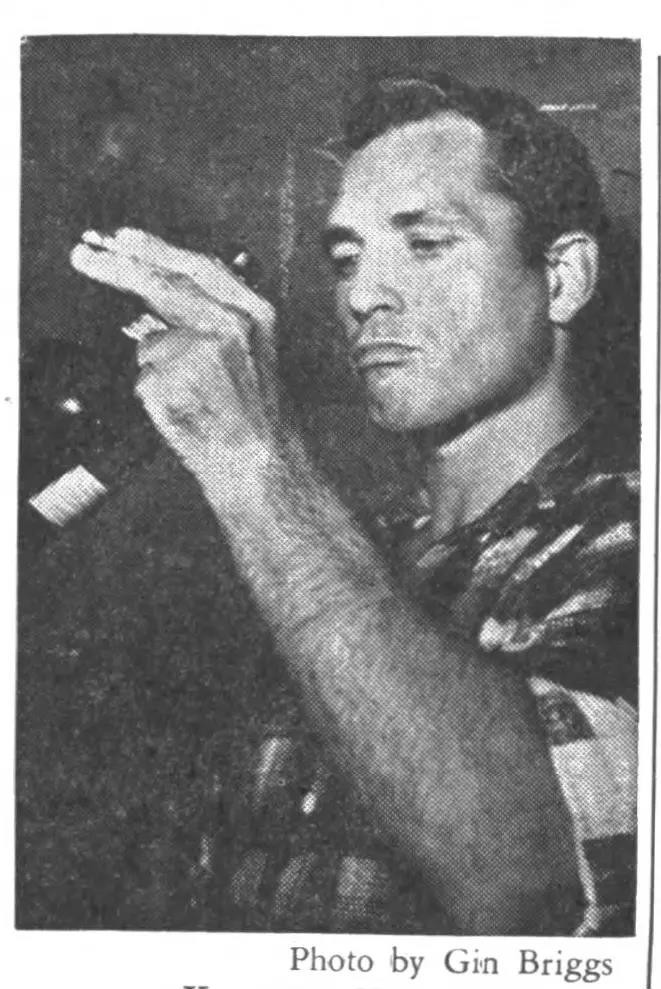
Although the surviving photos taken by Gin Briggs don’t show any direct confrontations or hat removals, there is a shot of Kerouac playing the piano and another of him with a bottle of brandy.[1]
The audio recording, transcripts, recollections, and newspaper articles all attest to the fact that Jack Kerouac and Kingsley Amis did indeed meet and had some interaction, however briefly. Unlike Weshler and Montagu, Kerouac and Amis were both writers, and Amis’ remarks were almost entirely oriented around writing. First off, he disavowed the “Angry Young Men” label that had been thrust upon him and then, regarding Kerouac and the Beats, he urged the audience to separate the man from the movement. He established his common calling with Kerouac when he pointed out what any writer is attempting to do:
They’re all working as best they can in their own way, and if their work is to have any value it will have the kind of value that imaginative writing has always had… as a series of statements about human character and human relations.’[xxxii]
Kerouac and Amis were both literary craftsmen working in poetry and fiction. Despite the stories of On the Road supposedly emerging from a frenetic three weeks of typing, the fact is that the story was assembled from scores of notes taken over a period of years and it was only published after later changes.
Although his writing was far more conventional, perhaps Amis did relate to Kerouac as a fellow writer. Beyond that, could there have been any sympathy, or perhaps recognition, of Kerouac’s embrace of alcohol? There in 1958, Kerouac was already on a trajectory that would eventually turn him into a parody of himself. Kingsley Amis was also destined for a similar outcome, although it occurred much later in his life. Did Amis perhaps catch a glimpse of his future self, there in the Playhouse?
Or do we need to recognize that Kingsley Amis was at heart a contrarian? Comparing the writing styles of On the Road and Lucky Jim, I can readily see Amis siding with the school of thought: “That’s not writing, that’s typing,” regarding On the Road. But despite that perception, it would be just like Kingsley Amis to take Kerouac’s side, simply because the other two speakers were against him.
Unlike the other two speakers, Amis never attacked Kerouac. He never slipped into a condescending superiority. He, more than any of the others, including Kerouac himself, focused on the stated topic of the event. He poked fun at Kerouac’s longwindedness, and the fashion senses of the Beat Generation, but he was never critical—not even constructively critical. Either he held fire out of respect for a fellow writer or he honestly felt that Jack Kerouac was a literary voice that needed to be heard.
The panel discussion at Hunter College was a singular event in many ways. Along with being the forum where Jack Kerouac and Kingsley Amis crossed paths, it was also a significant event in Beat history—a considered attempt to define the generation.
[1] An interesting side note for Beat and countercultural fans: Gin Briggs took a photo of Bob Dylan in July 1961 as he was performing at Café Wha? He was a complete unknown at the time and was unidentified in the caption.
[i] the village VOICE, Vol. IV, No.4, November 19, 1958, pg. 1
[ii] Reflections of an Angry Middle-Aged Editor, by James Weshler, 1960 Random House, Inc.; pg. 4-5
[iii] the village VOICE, Vol. IV, No.4, November 19, 1958, pg. 1
[iv] Reflections of an Angry Middle-Aged Editor, by James Weshler, 1960 Random House, Inc.; pg. 3-4
[v] NYC Municipal Archives WNYC Collection (Annotations: The NEH Preservation Project); A Paradigm Shift for the Beat Generation
[vi] Ibid.
[vii] the village VOICE, Vol. IV, No.4, November 19, 1958, pg. 1
[viii] Reflections of an Angry Middle-Aged Editor, by James Weshler, 1960 Random House, Inc.; pg. 7
[ix] NYC Municipal Archives WNYC Collection (Annotations: The NEH Preservation Project); A Paradigm Shift for the Beat Generation
[x] Ibid.
[xi] Ibid.
[xii] Ibid.
[xiii] the village VOICE, Vol. IV, No.4, November 19, 1958, pg. 3
[xiv] NYC Municipal Archives WNYC Collection (Annotations: The NEH Preservation Project); A Paradigm Shift for the Beat Generation
[xv] Ibid.
[xvi] Ibid.
[xvii] Ibid.
[xviii] Ibid.
[xix] the village VOICE, Vol. IV, No.4, November 19, 1958, pg. 3
[xx] NYC Municipal Archives WNYC Collection (Annotations: The NEH Preservation Project); A Paradigm Shift for the Beat Generation
[xxi] Ibid.
[xxii] Ibid.
[xxiii] the village VOICE, Vol. IV, No.4, November 19, 1958, pg. 3
[xxiv] NYC Municipal Archives WNYC Collection (Annotations: The NEH Preservation Project); A Paradigm Shift for the Beat Generation
[xxv] Ibid.
[xxvi] Ibid.
[xxvii] Ibid.
[xxviii] Reflections of an Angry Middle-Aged Editor, by James Weshler, 1960 Random House, Inc.; pg. 5-9
[xxix] Daily Princetonian, November 16, 1958, pg. 5
[xxx] The Allen Ginsberg Project; Is There a Beat Generation? (Brandeis/NYC 1958), October 27, 2013
[xxxi] Ibid.
[xxxii] NYC Municipal Archives WNYC Collection (Annotations: The NEH Preservation Project); A Paradigm Shift for the Beat Generation
In doing research for an upcoming novel, I began re-reading a few stories that tell…
Here we go again... ‘Tis the season for selling stuff at a discount and as…
Over this past year, we have transitioned away from our old self-hosted website and towards…
The following is an excerpt from the forthcoming book, The Three Wives of Queer William…
Later this year, Beatdom Books will release three new titles. These are now available for…
Yesterday saw the release of the trailer for a forthcoming documentary about Jack Kerouac called…
This website uses cookies.